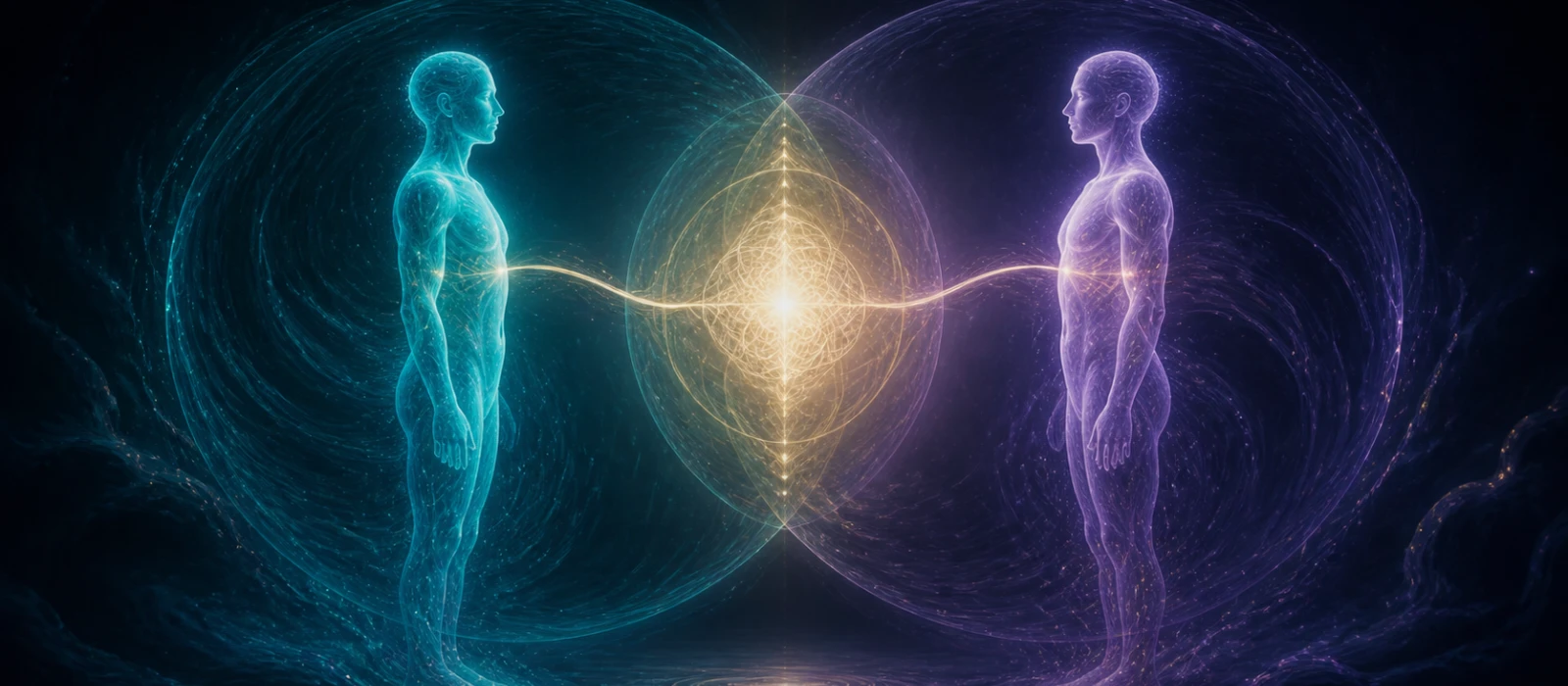
So far this series has only ever spoken of one self. A whirlpool, a chart that steers the ship, a performance given daily. But selves do not occur singly. And Marcus Schmieke shows that the coupling between two of them is not a new building block but is already contained in the three basic conditions his book has had from the start. No fourth principle required, none admitted — this step is tagged derived in the book.
Why understanding is not a miracle
What matters is what the third basic condition does here: it bounds the coupling. An encounter can shape an identity without dissolving it. Two selves can meet; neither can be absorbed. The same condition that made distinction possible at the very bottom of the book keeps persons distinct at its top.
For anyone who has been in a relationship where they felt they were losing themselves, that is a remarkable statement: the feeling of dissolving is real — the dissolution itself is, on this model, structurally excluded. What actually happens is something else: a coupling that reaches deeper than intended. And for that Schmieke has a classification.
Five grades of encounter
The coupling has exactly two parameters. Asymmetry: how unequal is the influence? And depth: how far down does it reach — does it only scratch the self-image, or does it enter the constitution of the identity? On the plane these two span, five regimes separate cleanly.
- Coexistence — symmetric, shallowTwo present to one another, neither moving the other. The stranger on the train. The contemplative witness. And, importantly: not every encounter has to be more.
- Alignment — strongly asymmetric, moderateOne is voluntarily shaped, the other barely. Apprentice and master. Service freely given. The asymmetry here is not a defect but the point.
- Mutuality — symmetric, moderateBoth shape each other in balance and develop shared patterns the coupled motion returns to after a disturbance, patterns neither possesses alone. That is, formally, the signature of friendship.
- Nurture — strongly asymmetric, deepOne identity is partly constituted by its relation to another that depends on it. The parental regime — and here the asymmetry is not the error but the point.
- Disclosure — symmetric, deepBoth identities constituted by the relation, and each remaining irreducibly itself. The only fixed point at which constitution and distinctness are simultaneously maximal.
Schmieke did not invent this fivefold structure — he derived the two parameters and watched the plane partition itself. That a classification of essentially this shape was articulated centuries ago in an aesthetics of relation — the five rasas of Rūpa Gosvāmī: śānta, dāsya, sakhya, vātsalya, mādhurya, in exactly this ascending depth — he records as a convergence. No derivation depends on it; the classification is derived, the readings are posited.
A side finding with real weight
Schmieke computes what the self actually does beyond merely owning its contents. Take two experiential contents with nothing whatever to do with each other, couple each only to the identity — and then integrate the identity out, and a binding appears between the two contents that was not in the original landscape at all. It arises from nothing but the fact that both belong to the same self.
And its strength depends on how strongly each of the two is appropriated. A content only weakly appropriated binds only weakly to the rest. A content not appropriated at all binds to nothing. This step too is tagged derived in the book.
I find that sentence remarkable for a very practical reason. It describes exactly what one observes in people who have not accepted an experience: it stands there, unconnected, without relation to the rest of their life. It can be told and changes nothing. And the work does not consist in processing it — but in first counting it among one's own. Only then does it bind to everything else, by itself.
Where a language lives
From this Schmieke draws a bold consequence whose source he names: Julian Jaynes's thesis that the narrative, self-attributing I is a recent cultural achievement and not a biological given. Read structurally, some of these standing waves do not merely carry selves — they build them: writing, codified law, narrative literature and reflective religion are external landscapes that stabilise the second reflexive order.
And then, in a single sentence, he sets three things side by side that one otherwise never sees together: the „voices of the gods“ of the archaic record, the modern narrative self and the meditative witness are three configurations of one structure — attribution absent, attribution gripped, attribution held lightly.
The third is expressly no regression to the first: the meditator keeps the capacity culture built and merely releases its grip. Whether history in fact ran this way is tagged open in the book — a matter for archaeology and philology.
And now the computation
Now to the question in the title. The Vedantic tradition names the real sat–chit–ānanda — being, consciousness, fullness — three moments of one reality, in that order of depth. Schmieke lays them beside his ladder, and they fit:
- Sat, being — the lowest order: settled value, the physical reading, distinction at rest.
- Chit, consciousness — the reflexive ascent: the motion that returns upon itself and knows itself.
- Ānanda, fullness — what the ladder does not reach. Not a further degree of self-modelling, but the question of the fulfilment of a self that is already self-aware.
And here the book does something I have seen in no comparable text: it distinguishes what the ladder itself runs together. Reaching the second order is not the same as being fulfilled on the second order. Self-consciousness and fullness are two things.
It is precisely at this seam that the contemplative schools have divided for a thousand years. The Advaita and witness traditions — Ramana Maharshi their purest modern voice — hold fullness to be ātmārāma: the self's contentment in the self, requiring no other. The Vaishnava traditions hold fullness to be constitutively relational: as rasa, realised only in exchange.
Schmieke put the question into a computable form and carried out the computation. The result is better than a yes or a no: the question splits, and both halves have an answer.
- The capacity closes aloneAn isolated system can reach the second order — it needs no partner to be a self-model at all. The ātmārāma position is structurally open, and as a computed fact rather than a polite concession.
- Fullness exists only in relationCouple two such systems and the first one's stream suddenly carries the joint pattern. Behaviour appears that an isolated stream can neither perform nor approximate — the lived space grows measurably in its dimension.
Both traditions therefore keep exactly what they most insisted on — on different layers of the same structure. In the chapter's own language: chit closes alone; ānanda is relational.
And beneath it Schmieke sets an algebraic result that looks like a footnote and is not: the unmediated self-return is zero. The operation cannot come back to itself directly — only by way of its results, that is, by way of what is other than it. Reflexion exists in this formalism only as mediated return: return to self by way of the other. That is the algebraic form of the old thesis that the I constitutes itself only at the Thou — derived here from a symmetry property, not assumed.
Too much distance — or too little?
The two most common relationship patterns are mirror images: withdrawing because you have learnt to need nobody — or clinging because you believe you have no self without the other. Describe your situation to me, and I'll look into your information field with TimeWaver technology: which patterns are showing resonance right now. You'll receive three personal impulses with one concrete starting point.
Start your free first analysisFree · no obligation · result within 48 hours
Frequently asked questions
Continue reading
This article reports ideas from a work of physics and philosophy and is intended as everyday orientation. All ideas and images are Marcus Schmieke's; the applications to everyday life are my own transfers and not claims of the book. The impulses described support general wellbeing and holistic balance. They are not a medical diagnosis, promise no cure and replace no medical or therapeutic treatment.