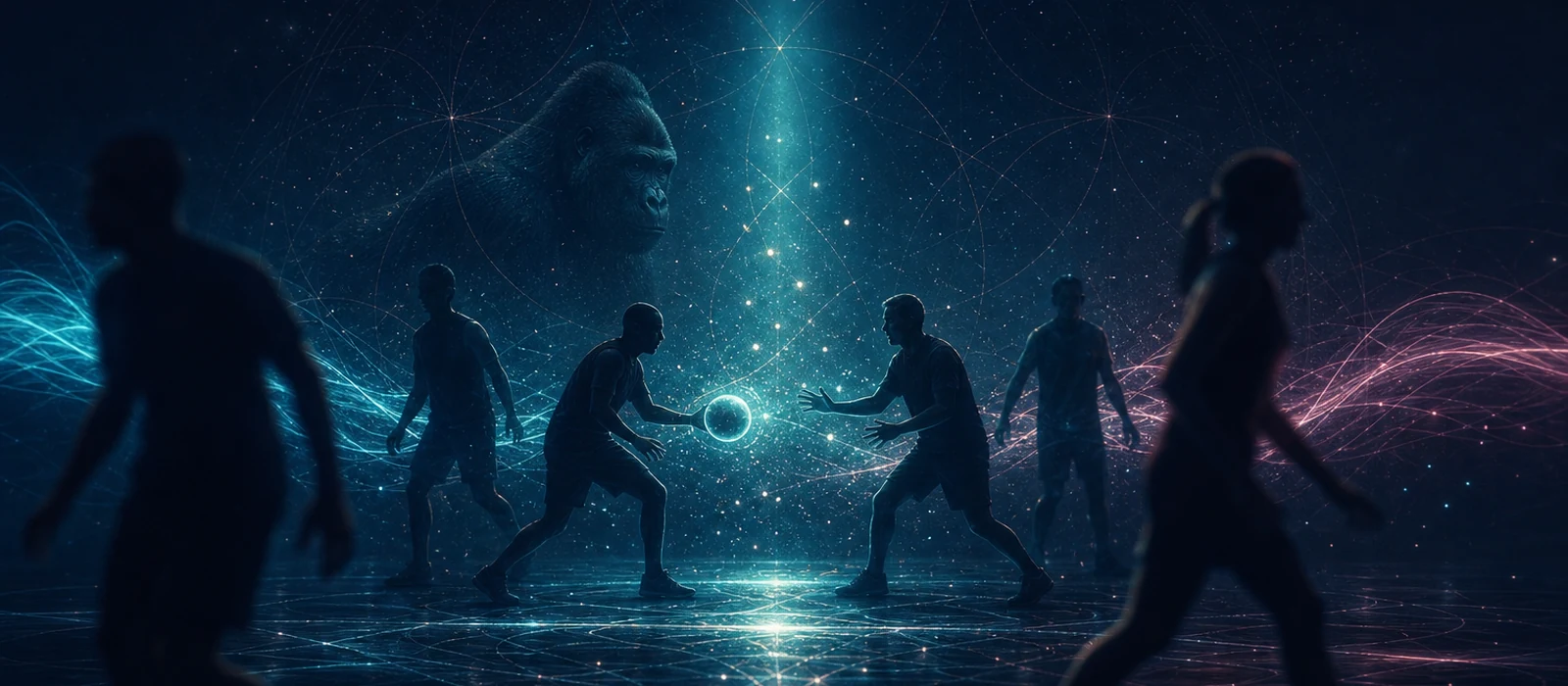
Imagine you are shown a short video. Two teams pass basketballs to each other, one in white shirts, one in black. Your task is simple: count the passes made by the white team. Only the white team. It takes concentration, because the players move through one another.
After about half a minute, a person in a gorilla suit walks into the middle of the frame, stops, thumps their chest, and walks out the other side. They are on screen for nine seconds.
Roughly half of all viewers do not notice. Not “only caught a glimpse” – they do not notice at all. They count the passes correctly, and when asked afterwards whether anything unusual happened, they say no.
The experiment that made psychology famous
The study comes from Daniel Simons and Christopher Chabris, then at Harvard University, published in 1999 as “Gorillas in Our Midst”. It has since become one of the most cited studies in the psychology of perception, and the phenomenon it demonstrates has a name: inattentional blindness.
One number deserves correcting at the outset, because it is often passed on wrongly. People like to say “50 per cent” miss the gorilla. In the original study it was around 46 per cent depending on the condition, and about 42 per cent in later replications. The effect is robust and repeatedly confirmed – the exact figure is not. It depends on how demanding the counting task is. Give people a harder version and more of them miss it.
For the point being made, this changes nothing. Whether it is four in ten or five: a substantial share of people miss something large, conspicuous and moving – in the middle of their own field of view, while paying full attention.
The part that is genuinely uncomfortable
The missing itself is remarkable. What follows it is what makes the finding uncomfortable.
People who miss the gorilla nearly all react the same way: with disbelief. Many insist they must have been shown a different video. And when people are asked beforehand whether they would notice such a thing, the large majority confidently say yes.
So we do not merely miss things. We are additionally convinced that we do not miss them. It is this second layer that makes the whole thing expensive – more on that shortly.
Expertise offers no protection
One might hope trained observers are exempt. A team led by Trafton Drew tested this in 2013, and the result is the strongest finding in this whole line of research.
Twenty-four experienced radiologists were given lung CT scans and asked to search for nodules – their daily work. Into the final case the researchers had inserted an image of a gorilla. It was forty-eight times larger than an average nodule.
Eighty-three per cent of the radiologists did not see it.
And here is the detail that genuinely struck me when reading it: the researchers also recorded eye movements. The majority of those who missed the gorilla had looked directly at it. Their gaze was there. Their attention was not.
This is not a criticism of radiologists – quite the opposite. It shows that years of experience do not abolish the filter. They sharpen it. Someone trained to search very precisely for one particular thing will search for precisely that one thing.
It does not stop at gorillas
Together with Daniel Levin, Simons ran another experiment that is almost more unsettling for everyday life. A researcher approached passers-by on campus asking for directions. Mid-conversation, two more researchers carried a door between the two – and behind that door the person asking was swapped for someone else.
About half of the passers-by did not notice. They finished giving directions to the new person.
Not a gorilla in a video. A human being you are talking to.
Why this happens
The obvious explanation would be that our eyes are too slow or our heads too full. Neither is right. The reason lies in how perception works at all.
The brain is not a camera recording what is there. It works with expectations: it continuously predicts what is about to come and processes above all the deviation from that prediction. Whatever fits the search pattern is let through. Whatever does not fit does not arrive – even though its light landed on the retina long ago. How these assumptions form, and why they are so persistent, I have described in more detail here.
And now the part missing from most articles on this topic: this is not a defect. It is the price of concentration. A system that treats everything as equally important can concentrate on nothing. The ability to count the passes and the ability to miss the gorilla are one and the same ability. They do not come separately.
The question is therefore never whether you filter. The question is what you are filtering for right now – and whether you still know it.
What it costs in everyday life
In the lab you count basketball passes. In everyday life we count too – we just do not notice, because nobody handed us the task. We set it ourselves, long ago, and it has been running in the background ever since.
- In relationships. Once you have formed a picture of someone, you start counting the evidence for that picture. The counter-examples happen – they simply do not arrive. After a few years you have a great deal of evidence and are convinced you are looking closely.
- With yourself. Someone who learned to attend to their own inadequacy will reliably count the moments where something falls short. The other moments are there. They are just not counted.
- In decisions. You see the options you are searching for. Someone who has assessed the same kind of option professionally for years will not reject the unusual one – they will simply not notice it.
- In your own story. Memory runs the same filter. Someone who tells their life as a chain of setbacks is not telling it falsely. They are only counting the setbacks.
The most expensive mistake
Back to that second layer I flagged earlier – because this is where the real cost sits.
People systematically overestimate how much they would notice. Research has a somewhat clumsy name for it: blindness to one's own blindness. And something uncomfortable follows: a blind spot you do not believe in cannot be compensated for.
Someone who knows they see poorly on one side turns their head. Someone convinced they see everything does not. That is why the sentence “I would have noticed that” is, in coaching, almost always a sign that it is worth looking more closely.
Why another person sees what you cannot
For me this is the practical core of the whole body of research, and I put it deliberately modestly.
A good coach does not see more than you. No better eyesight, no higher resolution, no special gift. They simply have a different counting task. They are not standing inside your story, have not spent years wearing in a picture of you, and therefore filter for other things.
That sounds unspectacular, but it is exactly why quiet self-reflection stalls at a certain point. You cannot examine your own filter using that same filter. You are looking through it.
The gorilla is always there. The only question is who happens to be counting in a way that makes it stand out.
What are you counting without noticing?
In a free first analysis we look together at the patterns running in the background – the questions you never ask yourself, because they do not even present themselves as questions.
Start your free analysisNo obligation, no account, no cost.
Frequently asked questions
Continue reading
This article reflects the state of research in perception and is intended as everyday orientation. The coaching methods described support general wellbeing and holistic balance. They do not constitute a medical diagnosis, promise no cure, and do not replace medical or therapeutic treatment.