Part two was about the difference between order that rests and order that circulates. But a whirlpool sustains itself without representing itself. A bacterium circulates without holding a picture of itself. And no amount of complexity on that layer ever produces a system that has a view of its own state.
To reach mind, Schmieke therefore adds nothing more complicated — he adds a layer.
The second layer
Above the layer of what a system is lies a second: what the system takes itself to be. Not an outsider's assessment, but its own internal distribution — where the system supposes itself to be. And the same equation runs on it once more, with the same three verbs, only with different meaning. What settles is no longer matter into order, but belief into consistency.
Schmieke's basic claim about mind is architectural: nothing new was invented for it. The same equation that spreads distinction and maintains life, applied one storey higher, is inference.
And then comes the guard that keeps the whole theory from declaring every statistical shadow a mind.
„But I know all this already“
Here it becomes interesting in practice. Because the most common state in which people come to me is not ignorance. It is knowledge without effect.
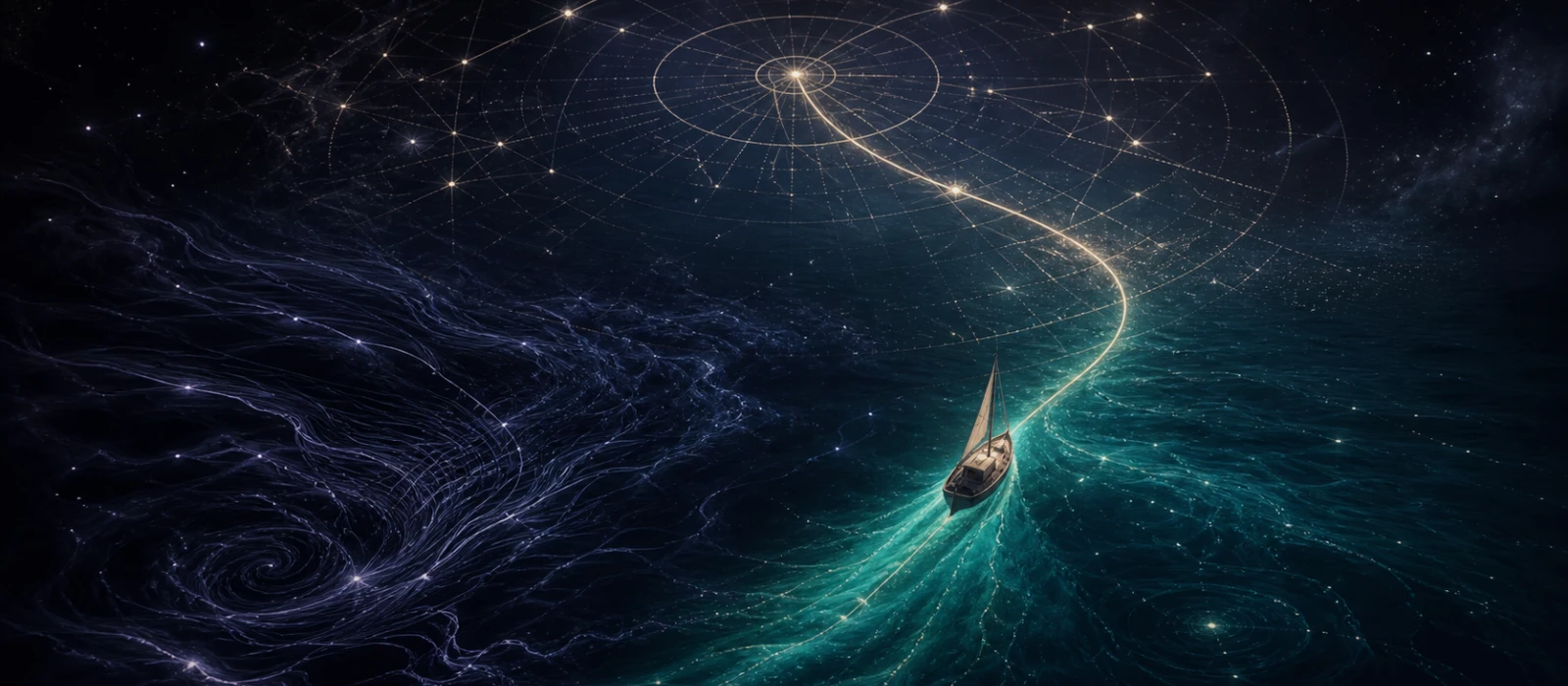
Someone can explain to you in five minutes why they keep choosing the same kind of partner. Where it comes from, when it started, what role their own childhood plays. The chart is drawn, it is detailed, it is probably even correct. And the ship keeps sailing the same course.
In Schmieke's language this is neither weakness of will nor resistance. It is a precisely describable situation: the distribution exists, but it is not in the causal loop. It does not change what the system steers toward. And as long as it does not, it is — technically speaking — not the system's belief but an observer's description. Only in this case the observer is oneself.
That is, I think, the most exact formulation of what I otherwise explain at length: why insight alone does not release patterns. Not because insight is worthless. But because an insight that changes nothing at the helm is, on this model, not yet the kind of thing that could change something.
Curiosity is the metabolism of the mind
One question remains: what keeps this second layer moving at all? Because a belief left to relax against fixed evidence comes to rest and stops inferring — exactly as a closed system runs to equilibrium.
What keeps it moving is action. The system actively seeks out the experiences that most reduce its uncertainty. It does something in order to find out how things are.
“Openness on the level of the body is metabolism. Openness on the level of belief is curiosity.”— Marcus Schmieke, paraphrased
A bacterium acts to feed. A human acts to know. A galaxy does neither.
A postscript that turns it all around
So far it has sounded as though mind were built on top of the body: matter first, then belief one storey up. Schmieke expressly withdraws that picture — and the withdrawal is not a detail but the position of the whole book.
The two layers are not storeys. They are siblings: two projections of one underlying motion, as light through a prism gives a red beam and a blue beam. And nobody asks how the red beam is built out of the blue.
This idea carries the rest of the series. It is also the point where Schmieke's model differs from almost everything else written about consciousness — and part 5 will show what follows from it for meditation.
You already know all this — and nothing changes?
That is the most common place people get stuck: the chart is drawn, and the ship keeps sailing the same course anyway. Describe your situation to me, and I'll look into your information field with TimeWaver technology: which patterns are showing resonance right now. You'll receive three personal impulses with one concrete starting point.
Start your free first analysisFree · no obligation · result within 48 hours
Frequently asked questions
Continue reading
This article reports ideas from a work of physics and philosophy and is intended as everyday orientation. All ideas and images are Marcus Schmieke's; the applications to everyday life are my own transfers and not claims of the book. The impulses described support general wellbeing and holistic balance. They are not a medical diagnosis, promise no cure and replace no medical or therapeutic treatment.