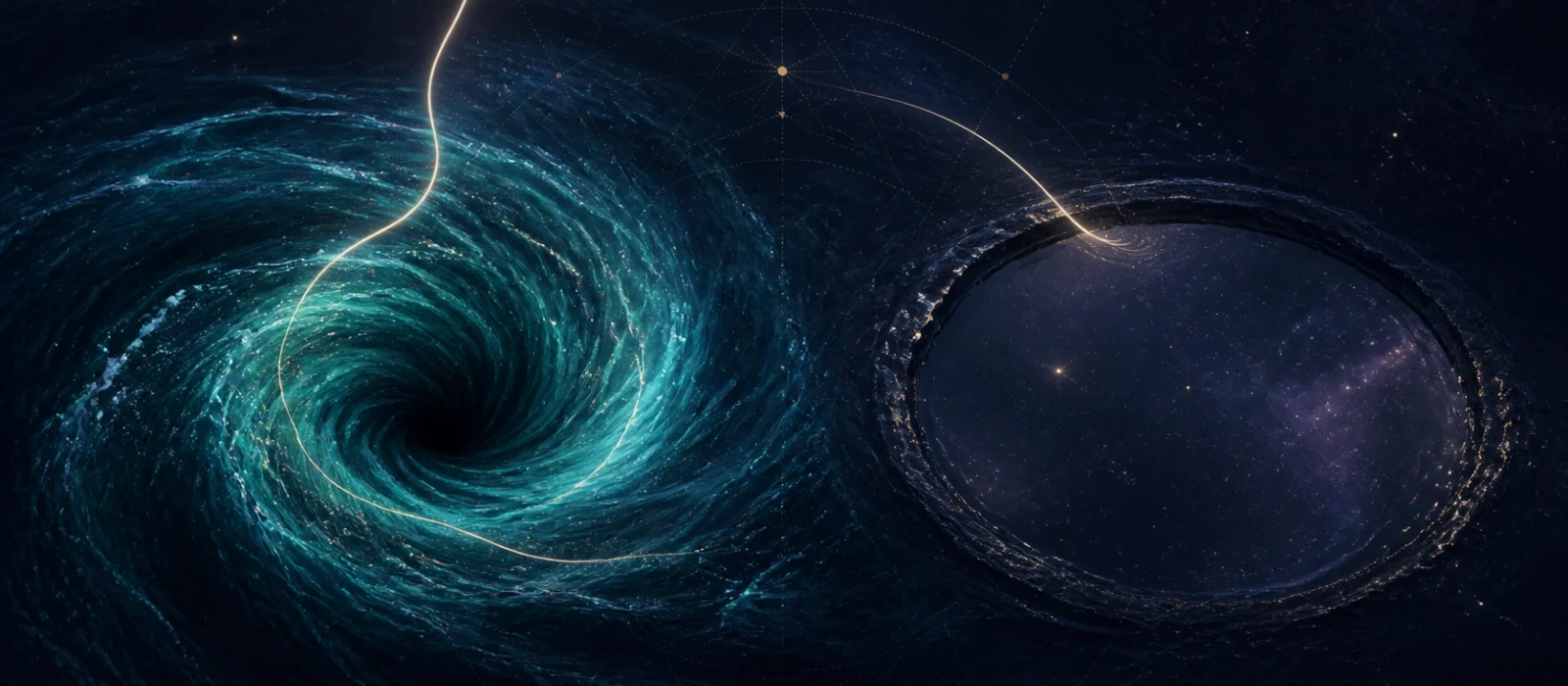
The first part of this series was about the three basic motions Marcus Schmieke derives from a single act: settle, turn, spread. I named three ways a life gets stuck there — and left one of them open, because it deserves its own article. The third. The one where nothing turns any more.
Two ways of holding the same shape
A system can hold its shape in two completely different ways. And from outside they look identical: a stable form that does not change over time.
Mathematically Schmieke frames this as a question about a current: resting order has a current of zero. Living order has a current that circulates and never stops. That the two cases really are distinct — that a shape can hold still while something circulates beneath it — is a theorem, tagged in the book as derived.
That the circulating variant is what life is Schmieke marks expressly as a proposal, not a proof — the book says posited there. He could easily have asserted it. He does not.
Living things must keep paying
And then he draws the consequence that makes this image so uncomfortable in everyday life. A living thing is open — it exchanges with its surroundings without pause — and precisely that being-driven from outside is what generates the circulating motion at all. A living thing is, in his phrase, a standing refusal to reach equilibrium.
The stone rests as far as anything can rest. The organism cannot afford to. It has to keep paying — and that is not a weakness but the condition of its being alive at all.
“An order that has stopped costing anything is already a puddle.”— Wolfgang Blüml
What this looks like in ordinary life
Transfer it to things that are not organisms and it becomes recognisable at once.
- A friendship you stop tending does not vanish dramatically. There is no falling-out, no break. It simply stops circulating. You would still like each other if you met — and you no longer meet. The shape is still there. The current is not.
- A team in which everything is regulated and nothing moves looks excellent on the org chart. The processes run, the meetings happen, responsibilities are clear. And nobody has had an idea in two years.
- A relationship can be perfectly orderly and completely lifeless. The division of labour works, the calendar is coordinated, there are no arguments. That is often exactly what unsettles: there is nothing you have to talk about. And so you don't.
- A daily structure that runs perfectly and in which nothing unexpected has happened for months is not a good daily structure. It is a funnel with the flow standing still.
The uncomfortable thing about this diagnosis is that it says the opposite of what we normally aim for. We work at making things calmer, smoother, less costly. And the point at which it finally runs smoothly is not rarely the point at which it has stopped being alive.
The straight path — and four ways to intervene
Schmieke goes one step further and draws a landscape on which a state moves. What matters is how this landscape measures distance: not how far apart two states are in space, but how easily one can be told from the other.
And out of this falls a classification I consider the single most usable idea in the whole chapter. There are exactly four ways to intervene in such a system.
- Change the speedYou change not the direction but the pace along the path someone is already on. Push or brake. In everyday life: more coffee, fewer appointments, a free weekend.
- Steer backYou push back toward the original path. This is the classic correction — and what most advice is: do it the way it used to work.
- Reshape the landscapeYou change the terrain itself, so that a different path becomes the straight one. Not back to the old normal, but a new one in which the path you are already on becomes the path of least effort.
- Change the structureRare and radical. In life: the move to another country, the complete change of profession.
The decisive sentence appears in Schmieke almost in passing: only the third can make the path someone is already on the optimal one — instead of forcing a return to a distant one. It is also the slowest. That is, in his own words, the difference between a change of life and a change of medicine. He tags the underlying cost function as posited, that is, as a modelling choice.
Two things I have left out here
Is it going well for you — or is it only still going?
The difference between whirlpool and puddle often goes unnoticed from inside for years, because both feel like stability. If a particular area came to mind while reading, describe your situation to me. I'll look into your information field with TimeWaver technology: which patterns are showing resonance right now. You'll receive three personal impulses with one concrete starting point.
Start your free first analysisFree · no obligation · result within 48 hours
Frequently asked questions
Continue reading
This article reports ideas from a work of physics and philosophy and is intended as everyday orientation. All ideas and images are Marcus Schmieke's; the applications to everyday life are my own transfers and not claims of the book. The impulses described support general wellbeing and holistic balance. They are not a medical diagnosis, promise no cure and replace no medical or therapeutic treatment.