Module in Detail
The Chakras
A Map of What Moves You
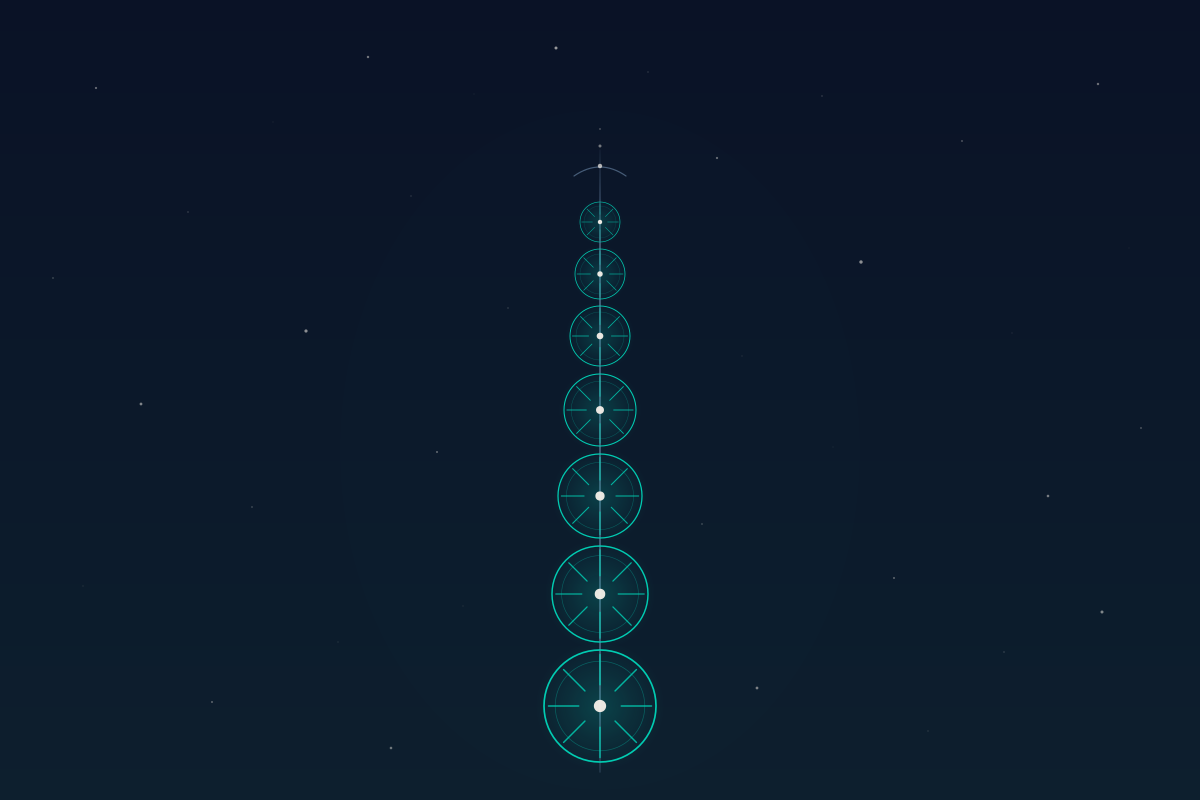
Chakra simply means “wheel” or “circle” in Sanskrit. What is meant are centres in which something gathers and turns — and where, consequently, it can also stall. It is one of the oldest maps human beings have drawn of their inner life.
Where the chakras come from
The idea comes from the Vedic and Tantric traditions of India; the first traces appear in the Upanishads, well over two thousand years ago. It was not devised at a drawing board but drawn from experience — from what people observed in themselves through long contemplation.
I spent years in an Indian ashram, and this is what still impresses me: this map was not thought up, it was lived. It describes no anatomy but spaces of experience — places in a person where certain themes keep showing up.
And one detail surprises many: the beautiful rainbow colours on every chakra poster today are considerably younger than the chakras themselves. They come largely from the early twentieth century, from the Western reception. The centres are ancient; the colours are a late translation.
Here too: no organs, no glands
Because the chakras are located along the midline of the body, the same short circuit suggests itself as with the meridians: that this is about body parts, about glands, about medical findings.
It is not. A chakra is not an organ and not a gland — it is a theme. The throat centre does not stand for your thyroid, but for whether you say what you think. The heart centre does not stand for your heart as a muscle, but for how much closeness you allow. Nothing here is measured on your body.
The Seven Centres
Each centre stands for a question that keeps returning in life. Read that way, they are what they can be in coaching: good questions, not findings.
Root — Muladhara
May I be here? Safety, ground under your feet, belonging
Sacral — Svadhisthana
May I enjoy? Pleasure, creativity, aliveness, flow
Solar Plexus — Manipura
May I want? Will, self-worth, the strength to stand up for yourself
Heart — Anahata
May I love and be loved? Closeness, compassion, forgiveness
Throat — Vishuddha
May I say what I think? Expression, truthfulness, being heard
Brow — Ajna
May I see what is? Insight, intuition, inner clarity
Crown — Sahasrara
Am I part of something larger? Meaning, connection, trust
What this changes in coaching
Read the seven questions one after another — and notice which one catches. Usually it is exactly one, and usually you know immediately.
That is the whole strength of this model: it gives people a language for something they feel but cannot name. “I never say what I really think” is a sentence you can work with. “I somehow don't feel good” is not.
Often it turns out the loud theme is not the real one. Someone comes about a career decision — and it is really about safety, right down at the root.
So what does the module do?
The TimeWaver Aura module analyses the energy of the chakras in the information field and displays them in the colours of the seven centres around your photograph — the stronger a centre appears, the stronger the field shows itself there. For centres with low energy, a deeper analysis follows, seeking positive information patterns for harmonisation.
In the end you hold a picture. Its value lies not in the picture but in the conversation that grows out of it.
Curious which centre is calling in you?
Tell me about your situation — you will receive three impulses from your information field, free, within 48 hours.