Module in Detail
The Meridians
The Map of Your Life Energy
For more than two thousand years, people in China have described the body not as a machine made of parts, but as a landscape with something flowing through it. The paths of that flow are called meridians.
What Qi actually means
Qi is usually translated as “life energy”, but that only gets you halfway. The original character depicts steam rising over cooking rice — what is meant is aliveness itself: breath, warmth, movement, the force that gets you out of bed and makes you want something.
Qi is not something a device could detect the way you detect current in a wire. It is a model of thought — a language for how people experience themselves. And as such it is remarkably precise. When you say you feel “blocked”, “drained” or “pent up inside”, you are already speaking in images of flow without noticing.
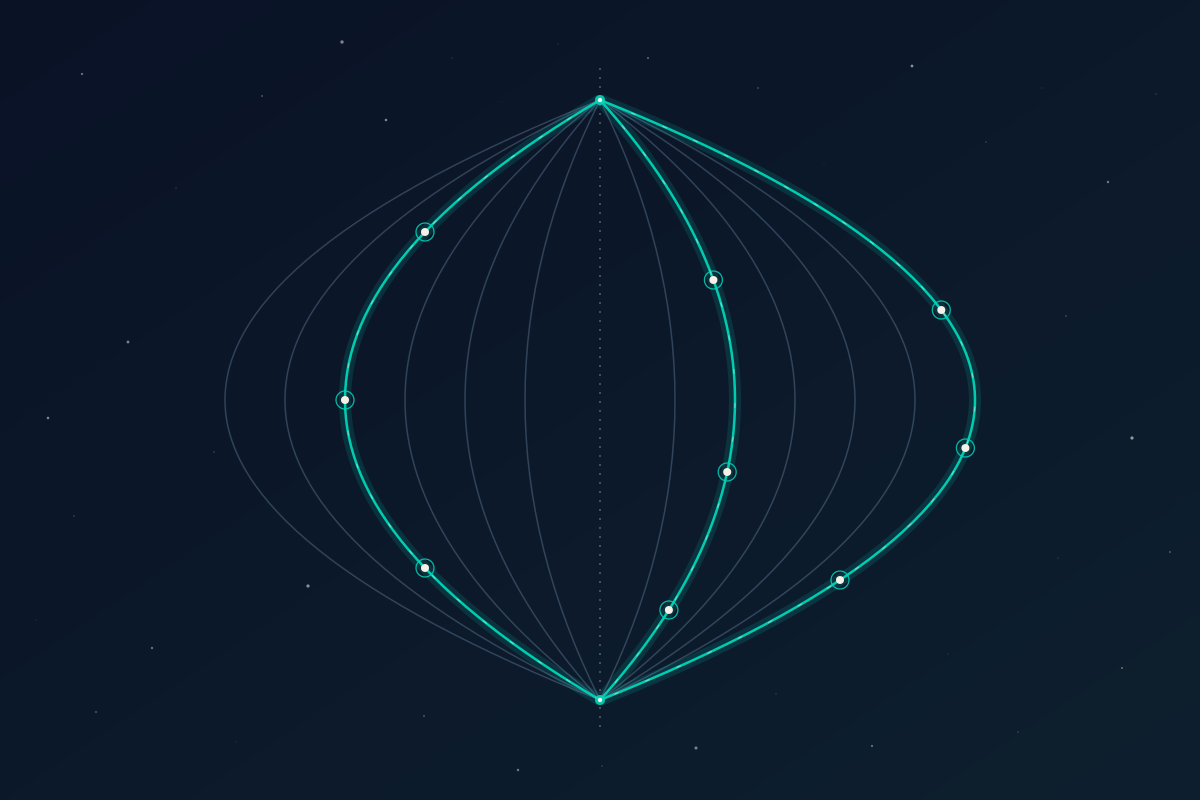
In this view the meridians are the channels along which Qi moves. Twelve main pathways, mirrored on the left and the right. Think of an irrigation system: what matters is not how many channels there are, but whether the water reaches everywhere — or whether it stalls, backs up or seeps away somewhere.
Why the “liver meridian” has nothing to do with your liver
This is where the biggest misunderstanding arises, so let us clear it up straight away. The meridians carry organ names — liver, kidney, heart, lung. Anyone hearing this for the first time inevitably thinks of anatomy, and of medical findings.
But something entirely different is meant. In the Chinese view, a meridian name does not stand for an organ but for a functional circle: a theme, a quality, a particular kind of movement in life. “Liver” refers to flow, to planning, to vision — and to what happens when all of that hits a wall: frustration, irritability. “Kidney” refers to primal strength and reserve, to staying power, and to the fear that surfaces when it runs thin.
A functional circle, then, is not an organ but a map of inner states. This is not a legal nicety, it is the heart of the matter: nothing here is measured on your body, and nothing is claimed about your organs. This is about themes, not diagnoses.
The organ clock
A lovely companion idea from the same tradition: the day is divided into twelve two-hour stretches, and each meridian has its own hours, in which its theme is especially present. The early morning belongs to the lung, the late afternoon to the kidney, the hours after midnight to the gallbladder and the liver.
This is an invitation to think, not an interpretation machine — and explicitly not a diagnosis. But it does prompt a good coaching question: is there a time of day when the same thing keeps meeting you? And which theme is holding on so stubbornly there?
The Twelve Pathways
Each meridian stands for a theme. The associations come from the traditional Chinese view — read here as what they can be in coaching: questions, not findings.
Lung
Breath, boundaries, letting go — and the grief when something has to leave
Large Intestine
What you hold on to, and what you are finally allowed to release
Stomach
Taking in and digesting — impressions, news and expectations too
Spleen
The centre, the nourishing, the caring — and the brooding it can turn into
Heart
Joy, connection, the quiet centre you decide from
Small Intestine
Separating what matters from what is merely loud
Bladder
Endurance, reserves, keeping going over long distances
Kidney
Primal strength and will — and the fear that surfaces when both run thin
Pericardium
The guard around your heart: how much closeness do you allow, how much distance do you need?
Triple Burner
The interplay of levels — warmth, balance, inner communication
Gallbladder
Decisiveness, and the courage to take the next step
Liver
Flow, planning, vision — and the frustration when nothing moves
What this changes in coaching
Most people arrive with a question that sounds like “What is wrong with me?”. The meridian perspective asks a different one: where is something stalling right now — and which theme is attached to it?
That difference is palpable. The first question looks for a defect. The second looks for a movement that has come to a halt — and that can be set going again. It turns a condition into a theme you can actually talk about.
So in a session we never look at all twelve pathways at once. We take the two or three that show themselves most clearly and work with those. Anything else just costs you your focus, and in the end nothing has really been touched.
So what does the module do?
The TimeWaver Meridian module analyses the energy of the meridians in the information field. The twelve main meridians are considered on the left and the right; where values sit outside the coherent range, we look more closely and harmonise within the information field.
What comes out of it is an impulse for our conversation — not a finding, and not a verdict about you. The device provides a prompt; the work happens between the two of us.
Curious what shows up for you?
Tell me about your situation — you will receive three impulses from your information field, free, within 48 hours.