I have read everything Marcus Schmieke publishes for years. In the summer of 2026 he finished a book unlike anything before it: The Architecture of Distinction, 390 pages — and the first two hundred and fifty of them are physics of a severity where I, as a non-physicist, drop out.
But the last hundred and fifty pages are not about physics. They are about life, mind, the self, encounter, freedom. And they treat all of that in a language you can follow, if you are willing to read slowly. This series is my attempt to retell it so that it lands in ordinary life.
It begins with a single stroke
The book does not start with matter, nor space, nor time, not even with number. All of that is supposed to come out at the end — you may not help yourself to it at the start. So what is left when everything is set aside?
One single act: telling one thing from another. Drawing a boundary. Setting a here against a there. The mathematician George Spencer-Brown showed in 1969 that a complete calculus can be unfolded from that one instruction — „draw a distinction“. Schmieke takes it as his only foundation stone.
And he sharpens something easily missed. The first distinction does not separate two things. At the beginning there are no two things yet. It sets two places under a single condition: that they must differ — and says nothing whatever about what will fill them. Difference comes before what is differentiated.
You meet this idea in your own life the moment you stop treating it as abstract. Before a person can say what matters to them, they first have to be able to tell one thing from another at all. A conversation that distinguishes nothing is not a conversation. A decision that separates nothing is not one.
And the first, often hardest work in any accompaniment is never the answer. It is the distinction: what here is actually two things that I have been treating as one? Tiredness and reluctance. Obligation and affection. Fear and caution. Whoever separates those pairs has most of the road behind them — why understanding alone still isn't enough, I've written up here.
A law with three verbs
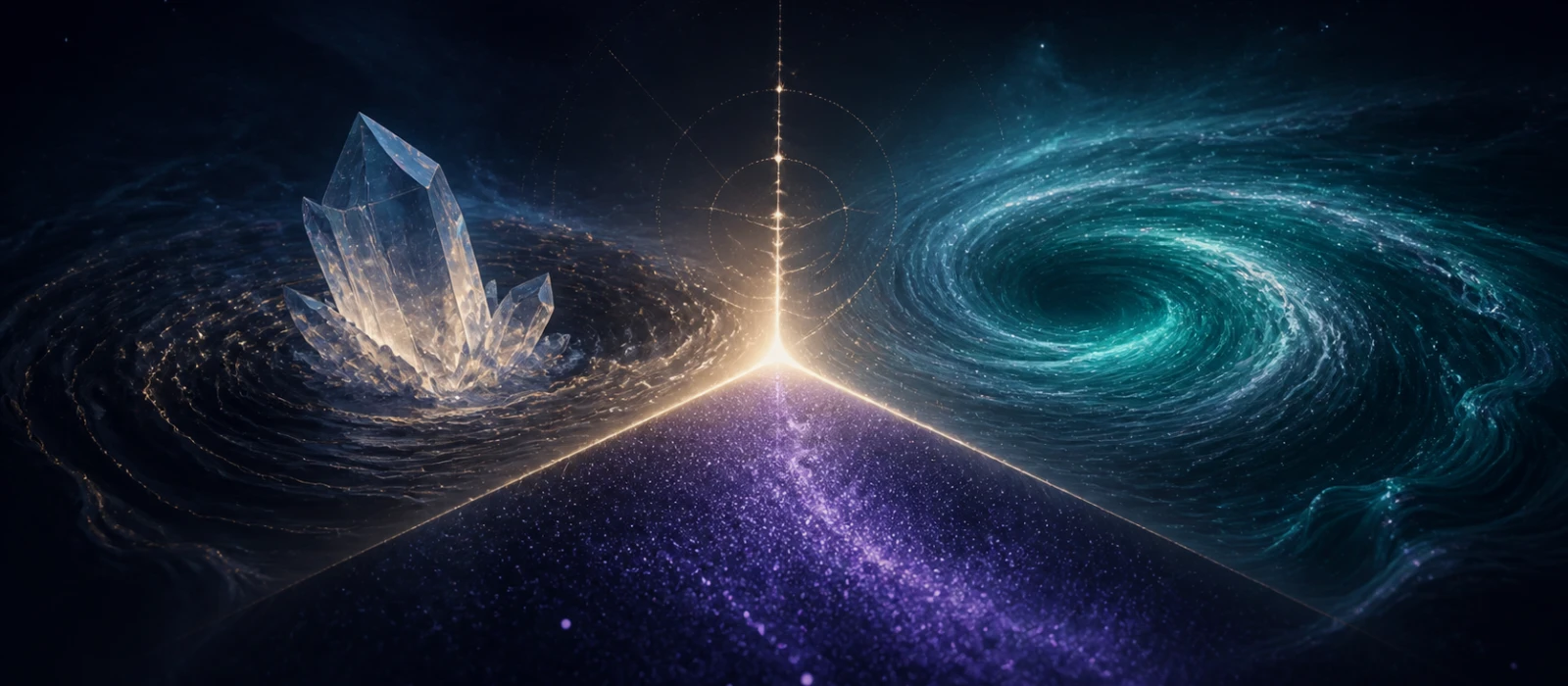
From that single act Schmieke obtains one equation, which he calls the Mother Equation. It has exactly three terms, and read as prose it says: possibility does three things and only three.
- It settlesIt flows downhill, into the valleys of the landscape. The undecided becomes decided. Without it there would be no definite things — only an endless perhaps.
- It turnsIt circulates along the contour lines. This motion never runs out. Without it there would be no happening — and, as part 7 of this series will show, no time.
- It spreadsIt blurs against the settling. Without it everything would freeze into points — and distinguishability would be at an end.
Settle, turn, spread: be something, keep happening, stay open. Schmieke shows that exactly these three are needed, because coherent structure has exactly three requirements and each term protects exactly one of them. Remove one and precisely the capacity it carried breaks. He tags this step derived — proved, not conjectured.
Three ways a life gets stuck
Now it turns practical. Because if there are only three motions, there are only three ways the balance can tip. And everyone knows them.
- Too much settling, too little spreading — rigidity. Everything is decided, fixed, regulated. The calendar is full, the opinions are in place, the routine runs. It looks like order and feels like safety. It is rigidity: nothing can change any more, because no room is left. People in this state often say everything's actually fine with me. And they don't mean it as good news.
- Too much spreading, too little settling — dispersal. Everything stays open, nothing is ever decided. Five ideas, three trainings, seven unfinished projects. It looks like freedom and feels like possibility. It is dispersal: a hundred possibilities and no reality. People in this state say I simply don't know what I want.
- No turning — standstill. Everything is orderly, and everything is quiet. This is the most dangerous state, because from outside it looks the best. The whole second part of this series is devoted to it — because it is the difference between a whirlpool and a puddle.
A very old correspondence
Later in the book, in the chapter on the Vedic correspondence, three ancient names meet these three terms. In Sāṅkhya philosophy the three basic qualities whose interplay makes up every state are called the guṇas:
- Rajas, striving, directed action — that is the settling.
- Sattva, clarity, the light of knowledge — that is the turning.
- Tamas, veiling and dissolution — that is the spreading.
That the three never act alone is, in the tradition, a doctrine. In the equation it is a triviality: all three terms are present in every configuration, and none may vanish. Schmieke tags this correspondence posited — a named translation, explicitly not a proof.
In passing he corrects an earlier assignment in his own work, where the first two were interchanged. A small thing — but it says something about how this book is written.
Why I am writing this series
Over many years I have read a great many texts that claim big things and prove small ones. This book does the opposite — and that is the real reason for this series.
Schmieke marks every single claim with a tag. Derived means proved from what came before. Posited means assumed because it fits — not proved. Open means we do not know. These tags stand in the book beside every sentence of weight, and I am carrying them into this series.
Whoever reads them along the way ends up with something no promotional text ever delivers: knowing exactly where the thing holds and where it is a bet.
Which of the three motions is missing for you right now?
Rigidity, dispersal and standstill feel completely different — and need completely different first steps. If one of them caught you while reading, describe your situation to me. I'll look into your information field with TimeWaver technology: which patterns are showing resonance right now. You'll receive three personal impulses with one concrete starting point.
Start your free first analysisFree · no obligation · result within 48 hours
Frequently asked questions
Continue reading
This article reports ideas from a work of physics and philosophy and is intended as everyday orientation. All ideas and images are Marcus Schmieke's; the applications to everyday life are my own transfers and not claims of the book. The impulses described support general wellbeing and holistic balance. They are not a medical diagnosis, promise no cure and replace no medical or therapeutic treatment.