Module in Detail
Artificial Intelligence
What It Can Do — and What It Certainly Cannot
Few things attract as much nonsense right now as AI. So here is an honest attempt: what does an artificial intelligence actually do in an information field analysis — and what does it definitely not do?
Let us start with what it cannot do
An AI does not understand you. It does not know you, it feels nothing, and it has no idea what it is like to be a human being. What a language model does, at heart, is predict which word is likely to come next — trained hundreds of billions of times on virtually everything people have ever written down.
That sounds sobering, and it is meant to. Anyone telling you the AI “recognises your soul” is selling you something. It recognises patterns in language. Nothing more.
But — and here it gets interesting — recognising patterns in language is no small thing. Because that is precisely what we humans are remarkably bad at, the moment it concerns ourselves.
What it is genuinely good for
People rarely arrive with a neatly sorted concern. They arrive with a tangle: a bit of work, a bit of relationship, an old story with their father, exhaustion, and somewhere in there the question of why they can never decide anything.
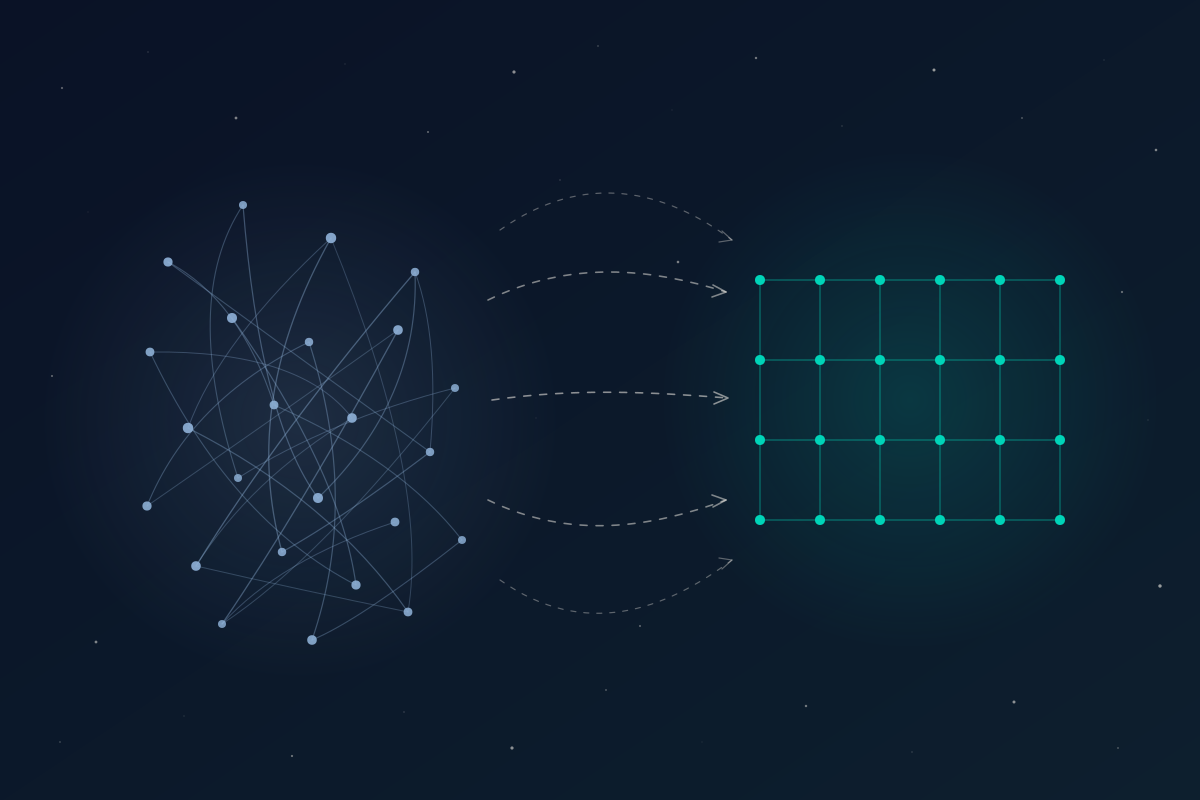
Pulling that tangle apart — seeing what it is really about, and which themes lie underneath — is something an AI does astonishingly well. It does not get tired, it does not have a bad day, and it has no favourite theory it would like to read you into. We coaches all have one.
So it is something like a very thorough assistant who sorts the material before the actual work begins. The work itself — the conversation, the understanding, the sitting with what is hard — it takes from nobody. The manufacturer says this very plainly, incidentally: the module is “no substitute for your competence, but your co-pilot”. There is nothing to add to that.
How a QI analysis runs
Six steps, from the theme to the report. What the AI does and what the information field does is stated explicitly.
1. Your theme
You describe your question or your situation — in your own words, as unsorted as they currently are
2. The AI reads along
It identifies the core: what this is actually about, beneath what you tell first
3. It structures
Matching categories and entries are created — a map of the theme, still without any judgement
4. Analysis in the information field
Only now does TimeWaver come in: the entries are analysed in the information field and ordered by intensity, potency and relevance
5. Turning toward the positive
Whatever shows up as burdening is translated into activating, positive formulations — the basis for harmonisation
6. Your report
At the end there is a summary and a structured report we work with together
Why I work with it
Honestly: because it saves time in the right place. The sorting, the categorising, the writing up — that is the work that used to eat hours and helps nobody when it is done badly.
What that frees up is exactly what you actually come for: the time between us. I am no longer half behind a screen, typing. I am listening to you.
And one more thing: a structured report you take home and read again in four weeks is worth more than the best conversation nobody remembers.
So what does the module do?
The TimeWaver QI module combines analysis in the information field with the pattern recognition of artificial intelligence. The AI opens up and structures the theme, TimeWaver analyses the entries in the information field, and at the end a summary, a report and a harmonisation list are produced.
The order matters more than it looks: the AI judges nothing. It sorts. Judgement happens in the information field — and the talking happens between us.
Curious what shows up in your tangle?
Tell me about your situation — you will receive three impulses from your information field, free, within 48 hours.